
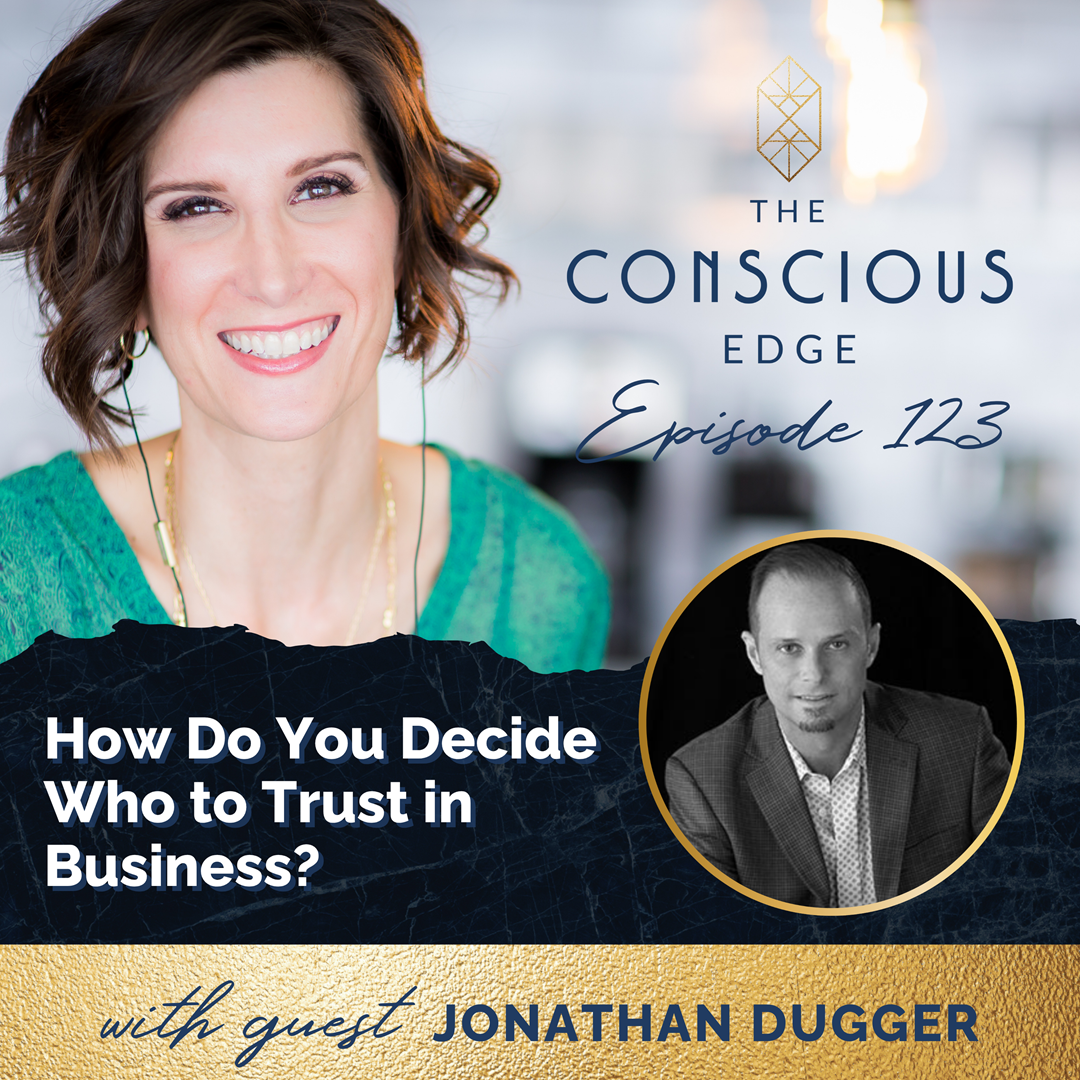
Cover picture for Episode 123 of The Conscious Edge Podcast with Alecia St. Germain and Jonathan Dugger on who to trust in business and judgment vs discernment

Judgment vs. Discernment: How to Decide Who to Trust in Business

October 20, 2026

Deciding who to trust in business starts with knowing judgment from discernment. Judgment hands down a fast verdict about who someone is. Discernment stays curious about the behavior, the context, and your own reaction, then decides. Your snap judgments still have a job, keeping you safe in a crisis and pointing you to your values, so let them happen, then get curious before you act.

Join Podcast Club

Get behind the scenes access to episodes before the public.

Meet other listeners of the show and connect live with guests, cohosts, and me.

Podcast Club turns passive listening into active connection.

Your privacy is important to us. Here is the link to our Privacy Policy.

​Someone says something in a meeting, and before they finish the sentence, the verdict is in. “What a jerk.” Your jaw tightens. You’ve already decided who they are.

Or it goes the other way. The offer drops on a webinar. Only the first people to buy get the bonus. Your heart is racing, and your hand is already reaching for your card before you’ve read the fine print.

Both of those are judgments. One slams the door. The other rushes you through it. Neither one gives you room to think.

In this Mindfulness Matters conversation, Jonathan Dugger and I break down judgment vs discernment. We also make room for what your judgment is there to do, because it often points straight to your values. Then we look at how to decide who to trust in business. Our example is the coaching industry, where making money can sometimes crowd out the customer.

In this episode on how to decide who to trust in business, you’ll discover:

  • The difference between judgment and discernment, and how to feel which one you’re in
  • Why judgment aims at a person while discernment looks at the behavior and the context
  • What your snap judgments are for, and when to trust your gut
  • How your judgments can point you to your values and your boundaries
  • Why a sales pitch can leave you feeling like you have to buy right now
  • Why curiosity helps you decide with more confidence
  • How to know if you need a therapist, a coach, a strategist, or a consultant
  • Four questions to ask any coach or expert before you hire them
What's the difference between judgment and discernment?

Judgment goes straight to a verdict. The gavel comes down, and the decision is made with nothing in between. It’s usually aimed at a person: “That guy is a jerk.” Discernment stays curious a little longer. It looks at the behavior, the context, and your own reaction before it decides. Jonathan Dugger, a licensed psychotherapist (LPC) with a doctorate in psychology, points out that you can feel the difference. Judgment runs hot. It feels angry, or it feels like a frenzy. Discernment feels curious and often compassionate. Judging doesn’t make you a bad person. Everyone does it, and it can point you to what you value. The shift is asking one question after the gavel drops. Is there something this person could do or say that would change my mind? Now you have something to go find out, and your decision gets built on real information.

Is it bad to judge people?

No. Everyone judges.  Jonathan Dugger, a licensed psychotherapist (LPC) with a doctorate in psychology, explains that snap judgments are wired into all of us, because some moments call for action with no time to think. Judgment can also show you what you care about. When something sets you off, it’s often because it goes against one of your values. Anger works the same way. It’s a cue. Trouble starts when the verdict becomes the final word and you act on it without checking. So let the judgment happen, then get curious. Notice where you feel it in your body. Ask what value it’s pointing to. Then decide what you’ll do about it. Sometimes discernment leads you to a boundary, like choosing not to engage with something that doesn’t fit what you stand for.

How do I decide who to trust in business?

Start with your gut, then give it five minutes. Jonathan Dugger, a licensed psychotherapist (LPC) with a doctorate in psychology, explains that snap judgments are built for life-or-death moments, when there’s no time to think. Most business decisions aren’t life or death. So listen to the signal, then ask where it’s coming from. Is it about what this person is doing? Or does it remind you of a bad experience, a bias, or a belief you grew up with? Next, ask questions. What training do they have for this work? What don’t they work with? What results can’t they promise? Then talk to more than one person. I always say interview three, because sometimes what felt like the right fit was just really good marketing. If you can’t make a call at all, that’s usually fear or avoidance talking. Curiosity is what helps you move.

Why do I feel like I have to buy right now when I hear a sales pitch?

That rush is your body getting revved up. Countdown timers and limited bonuses are built to create that feeling. Dopamine plays a part. It’s the chemical behind wanting, and it fires during the chase, before you have the thing. Think of the buzz you get with a full shopping cart before you ever check out. Fear of missing out can stir up the same frenzy. Underneath, there’s often a hidden belief working to keep you safe, something like “If I don’t act now, I won’t be successful.” In Immunity to Change® work, that’s called a big assumption. When you notice the rush, take a breath and get back in your body. Then ask yourself a few questions. Does this solve a real need in my business? Is the money there for it? Or does it just sound fun?

How do I know if I need a therapist, a coach, a strategist, or a consultant?

Start with what you need help with. If you’re dealing with trauma, depression, anxiety, or anything that needs a diagnosis or treatment, that’s the work of a licensed therapist or a doctor. Legal and investment questions belong with a licensed attorney or financial adviser. Beyond that, titles get blurry. Coach, consultant, and strategist aren’t regulated, so ask what you’ll walk away with and who does the work. A strategist is highly specialized and gives you the steps, and you or your team carry them out. A consultant is usually brought in to solve a specific problem in your business. A coach may offer general accountability, or may specialize in helping you understand why you keep getting stuck and how to move past it. Many people use more than one at a time. A therapist and a coach often work well together.

​A snap judgment at the bank

Jonathan was standing in line at the bank, in a hurry, when the man ahead of him started being rude to the teller. Jonathan’s first thought was, “What a jerk.” The verdict was in.

Then he noticed he was getting angry. He was impatient and running late, and that was feeding it. So he started paying attention. He noticed the man’s hygiene. His shirt was buttoned wrong. His behavior looked aggressive, but he was really asking for help.

The teller saw it too. She told him she wanted to help, but he needed to tell her how, because all he was doing was yelling at her. She stayed calm, and the whole moment shifted.

Jonathan’s snap judgment had nothing to do with what the man was doing. It was about who Jonathan decided he was. Once he looked at the context, he saw a completely different situation.

That’s the heart of judgment vs discernment. The first is a verdict about who someone is. The second looks at what’s happening and gets curious. Moving from one to the other changes what you can see, whether you’re standing in line at the bank or deciding who to trust in business.

Judgment vs discernment

Judgment hands down a verdict

In mindfulness practice, the goal is to stay out of judgment and in curiosity. Jonathan explains why. Judgment goes straight to a verdict with no process in between. He’s a visual thinker, so when he catches himself judging, he pictures Judge Judy bringing the gavel down. The decision is made before any facts come in.

Judgment also tends to aim at a person. “She is so lazy.” “That guy is a jerk.” Discernment aims at the behavior and the context. What’s going on around this person? What’s going on with me? I talk more about how judgment and criticism get in the way of connection in EP073: Comparison and Judgment in Entrepreneurship.

You can feel the difference in your body. Judgment runs hot. It feels angry. I’d add that it can also run hot in an excited, frenzied way, which I’ll come back to. Discernment feels curious and often compassionate.

One word can open the door to curiosity

Partway through our conversation, Jonathan caught something I said without thinking. I described a coach who claims to be your everything as “potentially” serving their ego. He pointed out that judgment would have said they are. That one word, potentially, leaves room for curiosity. It turns a sentence I’ve already passed into a question I can still ask.

“Judgment is usually aimed at a person. Discernment is aimed at a context and a behavior.” — Jonathan Dugger

What your judgment is trying to tell you

This is the part I wanted to make room for. Judging doesn’t make you a bad person. Everyone judges. Jonathan explains that snap judgments are wired into all of us for life-or-death moments, when there’s no time to think. In those moments, your gut keeps you safe. So trust your gut, and don’t ignore the signal.

Most decisions aren’t life or death, though. When you can, take five minutes to ask where the reaction is coming from. Is it what’s happening in front of you? Or is it an old experience, a bias, or a belief you grew up with that was never yours? Our snap judgments are often shaped by past experience, and five minutes is enough to check.

Your judgments point to your values

When I follow my own snap judgments back, they usually lead to my values. Political ads are my favorite example. When I brought them up on the episode, our Podcast Club members said amen in the chat.

When an ad spends its whole time tearing down the other candidate, my reaction is instant. It doesn’t sway me. It makes me think somebody needs a nap and a snack. What I want to say is, do what you do well and show me what you stand for. Tell me your platform. Then I can compare and contrast. Jonathan pointed out that attack ads give you nothing to be curious about. You’re asked to judge someone else instead of weighing the person asking for your vote.

That reaction is a judgment. So I get curious about it. Underneath, the ad goes against what I value. My discernment then becomes a choice. I don’t engage with that kind of message. That’s a boundary, and I talk about telling a boundary from avoidance in EP117: How to Tell the Difference Between a Boundary and Avoidance.

Anger works the same way. In EP094: Anger as Fuel: How Aware Leaders Use It Without Letting It Take Over, I talk about how anger can help you define your values and your boundaries. Anger is a cue. What matters is what you do with it. The more of us who use discernment to step away from behavior that doesn’t match our values, the less power that behavior has.

When judgment feels like excitement

Judgment can run hot like anger. It can also run hot like excitement. “If you don’t act now…” You get the FOMO and the frenzy. You’ve got to be first in line so you get the free book. This kind of judgment is easy to miss, because it feels good. It’s still a dysregulated feeling, and it leads to fast decisions you can end up regretting.

Here’s what’s happening underneath. Dopamine is the chemical behind wanting. It fires during the chase, before you ever have the thing. It’s the buzz of a full shopping cart before you check out. And your big assumption may be adding fuel. In Immunity to Change®, a methodology developed by Harvard faculty Dr. Robert Kegan and Dr. Lisa Lahey, big assumptions are the rules your unconscious made up about how the world works, designed to keep you safe. This one might sound like, “In order to be successful, I have to act now.”

That’s where discernment says slow down. Take a breath. Get back in your body. Then ask why you think you have to have this. Does it fill a real gap in your business? Is it something you were already looking for? Or does it just sound fun? Jonathan adds one more. Sometimes you don’t even need the thing. You just like the person and what they represent.

When I think I need something for my business, I take it to Jenn Baas, the financial strategist who leads our Financial Leadership Lab. We ask whether the money is there, what we expect it to produce, and how we’ll know if it’s working. Asking those questions gives me a lot more discernment.

Curiosity doesn’t slow you down

People tell Jonathan they don’t have all day to be curious. With practice, it happens in milliseconds. When someone gets stuck and can’t act, curiosity isn’t the cause. That’s usually avoidance or fear. Curiosity helps you take action based on real information. For me, curiosity is what makes it feel safe to move forward.

 “Curiosity makes it feel safe to move forward.”

Putting judgment vs discernment to work: the coaching industry

Coaching is our example of how to decide who to trust in business. Jonathan and I have both been seeing something there that worries us. People are losing trust in coaching and consulting. And this goes far beyond coaching. It shows up anywhere making money becomes more important than the customer.

My ask of my own industry is the same as my ask of political ads. Show people what you stand for. That’s why I have a no-jabs policy. I’m not here to put another coach down. I’m asking all of us to be professional and treat this craft with the respect it deserves. You wouldn’t practice medicine without being qualified. Coaching is a helping profession, and that means keeping a pulse on your own ego.

What we’re seeing

Jonathan has heard this firsthand at wellness conferences. During COVID, there was a real shortage of mental health providers. Some people stepped in to grow their skills and help. Others saw a chance to make money or build a social media following. Resources have improved since then. In Jonathan’s view, though, the problem of people practicing without the training, or promoting ideas with no research behind them, has gotten worse.

I see a version of this in the coaching world too. There’s a strong culture of coaches coaching coaches on how to build a coaching business. I’ve been part of it. When I first got certified, I knew how to do the work, but I didn’t know how to market it. I remember praying, “God, if you want me to do this, send me something so clear I can’t deny it’s my next step.” A marketing coach who worked with a lot of coaches showed up, and I got real help.

What concerns me is the push to scale at any cost. Group programs can be powerful, and there’s still a place for one-on-one work. But I’ve heard it taught again and again that you have to accept a drop in quality when you scale. People get fewer results. The wrong people end up in the program. As Jonathan says, when the focus is volume, the goal becomes getting someone in the seat and collecting the payment. Quality and fit get skipped.

Writing off a whole industry is a judgment too

When people get burned, the easy response is black and white. “Coaching is bunk.” “You can’t trust any of them.” I understand why people go there. It’s the gavel coming down again.

Someone in my mastermind made a fair point. Everyone’s an adult, and people get to choose who they work with. I agree that people aren’t victims. I also believe that in an unregulated industry, those of us providing the service have a responsibility to hold ourselves to a code of ethics, even when no one requires one. Jonathan and I both expect more regulation is coming. I’m not afraid of it. As long as it supports the industry, I’ll follow the rules so I can keep doing what I’m here to do.

Know what kind of help you need

Part of deciding who to trust in business is knowing whether a coach is what you need at all. Jonathan is clear that a coach practicing as a therapist is crossing a legal line, and so is someone giving the kind of financial advice that requires a license. (Fact check: In the US, states license mental health treatment, and practicing therapy without the required license can bring real legal trouble. The rules vary by state. Giving investment advice for pay generally requires registration too. Talk with an attorney about your specific situation.)

Trauma, depression, anxiety, or anything that needs a diagnosis and treatment belongs with a licensed therapist or a doctor. Beyond that, it gets confusing. Titles like coach, consultant, and strategist aren’t regulated, so almost anyone can use them. Two people with the same title can offer very different things. (Licensed titles, like psychologist or licensed counselor, are protected by law.) So look past the title and ask what you’ll walk away with and who does the work. Here’s how I define them.

A strategist is highly specialized. They give you the steps, and then it’s up to you or your team to carry them out. A consultant can also give you a plan, and is usually brought in to solve a specific problem in the business. Some consultants help put the plan in place too, so ask. A coach can be a generalist who offers accountability, or can specialize in helping you understand yourself, why you keep getting stuck, and how to move past it. You’ll also see blends, like a strategy coach, who teaches the steps in a coaching format.

Many of my clients see a therapist and work with me at the same time. We bring two different perspectives, and it works well together. Jonathan calls it a great pairing. I also work with a lot of people who have a strategy coach. That coach teaches the how. I help with the system of self-protection running underneath, when you’ve got one foot on the gas, ready to do the strategy, and one foot on the brake, because something feels unsafe.

So one coach can’t be your everything. If someone tells you they are, get curious. Part of my own training is checking how much of my big assumption is at play with a client. Good coaches check themselves.

How I answer Jonathan’s questions

Jonathan’s checklist below asks four questions of any coach. It’s only fair that I answer them too.

What training do you have for this specific work? I’m a Certified Immunity to Change® Coach. I’ve worked with the method since 2011 and completed my coaching certification in 2016. It’s a research-based methodology grounded in adult development and behavioral change. I also bring more than 20 years in training and curriculum design. And my training sits on top of lived experience. I grew up with parents who owned businesses, and I started my own entrepreneurial journey in my early 20s.

What don’t you work with? I don’t handle situations that involve deep trauma, like the trauma caused by abuse. I don’t treat mental health conditions, and I don’t make a diagnosis. I don’t give legal or investment advice. Many people need support in these areas, and we can still work together. I draw a clear line around what’s in my scope, and the rest goes to the right professional.

When do you refer someone elsewhere, and to whom? Whenever something comes up that belongs with someone else. I may ask you questions to help you pull out what you believe. And I will always tell you to follow up with the right professional, whether that’s a mental health provider, a physician, licensed legal counsel, or a financial adviser. On a first call, I tell people which parts of what they shared I can help with and which parts I’d advise them to see a therapist about.

What results can’t you promise? I don’t guarantee returns or a certain amount of business growth. What I do is ask questions that help you gather your own thoughts, discern the right next step for you, and follow through on your decisions. I help you look at the hidden competing commitments that may stop you from following through, so you understand why you feel and act the way you do.

“It is your responsibility as the consumer to vet people and to use discernment before you make that purchase.”

Why discernment matters

You probably know someone who says, “I don’t trust doctors.” So they skip the checkups. They don’t get the mole looked at. It’s cutting off your nose to spite your face.

Writing off every coach, or every expert in any field, works the same way. There are great people out there helping in a lot of different ways. Jonathan sees a growing group he calls the light bringers. They come from compassion and kindness, and more of them are looking for ways to collaborate instead of compete. That gives me a lot of hope.

As Jonathan puts it, judgment tends to shut everything down. Discernment opens things up. Curiosity leads to clarity, and clarity leads to a sound decision that fits your values and what you need. That’s the real gift of choosing discernment.

When you’re deciding who to trust in business, your part is to use discernment before you buy, partner, or collaborate with anyone. I always say interview three, even if the first person seems like the one. The more people do their part, the more they choose the people who are here for the right reasons. Your business benefits, and so does your life. The people here for the wrong reasons will either leave or rise to the same standard.

Maya Angelou taught that when you know better, you do better. That’s what I expect of all of us, including me.

How to Tell If a Coach Is a Good Fit

Jonathan Dugger put together this checklist to help you decide who to trust in business.

Hiring an expert means trusting what they tell you they can do. In coaching, titles don’t come with a guarantee, so a few questions up front can save you a lot of time and money. Ask any coach (or any expert) you’re considering:

  • “What training do you have for this specific work?”
  • “What don’t you work with?”
  • “When do you refer someone elsewhere, and to whom?”
  • “What results can’t you promise?”

A good coach answers these easily. Hesitation or defensiveness tells you something too.

Signs someone may be working outside their scope:

  • Claims to diagnose, treat, or cure conditions like trauma, depression, or anxiety
  • Discourages clients from therapy or medication
  • Guarantees outcomes (Jonathan and I call this the ick factor)
  • Has no clear answer about what they don’t work with or when they refer
  • Has vague credentials you can’t verify

Plenty of excellent coaches have no license, and licensed professionals can step outside their scope too. What matters is knowing what someone is trained to do and whether they’re honest about the edges.

About Jonathan Dugger

Jonathan Dugger is the founder of Mindful Rise Consulting, where he helps entrepreneurs, leaders, and teams define success on their own terms and grow toward it without burning out. He holds a doctorate in psychology and is a licensed psychotherapist (LPC) and mindfulness teacher. He formerly practiced as a licensed clinical and sport psychologist. He has also been building and running his own businesses since 1995, so he knows the highs and lows of leading under pressure from the research and from experience. As Alecia’s longtime business partner and the resident wellness advocate on The Conscious Edge® Podcast, he hosts the Mindfulness Matters with Jonathan segment and brings research-grounded mindfulness to the human side of leadership.


Resources and Links Mentioned

When you’re not sure what your business needs or what kind of help can fill the gap, start with a call, and we’ll pin down what specifically needs solving. I’ll help you discern your next step, and you can bring Jonathan’s questions and ask me every one.

Full Transcript Here

Alecia St. Germain 00:00
There are a lot of people out there vying for your attention. A lot of people telling you that they have the answer to your problem, and a lot of people who would love to do business with you. And it can be really hard to tell who really is going to be for you and what makes sense for your business. And when you are getting caught up in the rush of the dopamine of the sales, and not wanting to miss out, and having that FOMO that comes up for people. So today's episode is going to be about discernment versus judgment, how to go through the discernment process, and maybe even think about some things you need to think about before you choose to hire someone to help you in your business or for really life in general and who you want to trust and let into your space, so let's dive in. Hey, you leader, entrepreneur, business owner, solopreneur, whatever you call yourself, we know you're a visionary business builder, wealth seeker looking to combine a passion for doing good with leading consciously. It's time to shift from a traditional focus of pure wealth accumulation to one that integrates well-being and fulfillment. You're here for a purpose, and it's time to shine your light. So here we go. Welcome back to the Conscious Edge podcast. I'm your host Alecia Saint Germain here with Jonathan Duggar today. Hi, Jonathan. How are you?

Jonathan Dugger 01:37
Hey, Alecia. I'm doing pretty well. Fending off some sniffles like you as well. Yeah, we were not in the same space.

Alecia St. Germain 01:46
You've been at several conferences the last couple of weeks, traveling around to some wellness conferences, and I came to you and I was telling you that there's some things that I'm seeing in the coaching space that are a little alarming, a lot alarming, really, for me. And you are sharing the similar sentiment. And one of those things being that people are developing a huge distrust for the coaching industry. I think for consultants, for a number of individuals, I should say, like industries, but really the coaching and consulting industry overarch, and you saw some of the same thing at the conferences that you came up with. What was your experience?

Jonathan Dugger 02:30
There are a lot of folks that have entered into the coaching and consulting world from a place of necessity. This was just came up last week. The conference I was at in Boston that during COVID there was just such a shortage of mental health providers of people that could be considered resources for helping people plug into other resources like advocates that kind of thing, and so some people saw that as an opportunity to expand their skill set and expand their range of practice. Others saw it as a place to make money and a place to get a TikTok presence or some other sort of social media presence. And even though resources have improved since then, the folks that are practicing in an inappropriate way, from a standpoint of just not being qualified, or promoting something as fact that's baseless in terms of actual research behind it, authority behind it, any sort of practice authority behind it, it's gotten worse, and in some cases dangerous. There's a lot of one of the sessions I was in San Diego a couple of weeks ago was looking at some of these advocacy practices with youth, with high school age students, and there's these whole organizations that have developed these advocates slash coaches for kids that have no educational background, they have no experience background, but what started in a place which I think was a very helpful place of kind of like a boys and girls club, and this was in California specifically, but has become this place where kids are coming in for counseling with very unqualified people, and there have been a range of very traumatic events that have happened due to that. So that's kind of the extreme of things that are happening. But there's a lot of places in the more in the middle of that where people are getting just bad advice, coaches are taking on, and I'm using air quotes for coaches are taking on clients that are not a good fit, but they need the money, they need the exposure, whatever it is, and like you said, this is causing a public. Response of the coaching industry is bunk. The coaching industry we can't trust it. The coaching industry is unqualified, and because unfortunately we live in a society that often goes to the black and white, or without looking at the middle ground. And I just want to be clear that I'm not in any way, shape, or form saying I'm not fallible. My background's better than your background. My anything like that. This is all about this. This whole subject area is about discernment. Us figuring out the right process to get to making good decisions. That's helpful for everybody.

Alecia St. Germain 05:34
And I think my perspective on it very similar to yours. I was sitting in a mastermind last week, and we were talking about how do we, how do I, because I clearly have a very strong feeling about this, an opinion about this, and how do I plan to move forward without taking a jab at because one of my values is I don't want to take jabs at other people because I think everybody is on their journey and I really like to believe that we are all humans trying to figure it out and we are going to make mistakes and when you know better, I hope that you do better. That's my expectation of humanity and people: is that when you know better, you do better. Does everybody make that choice? Maybe not. And if they don't make that choice, then I question myself and I say, "What is going on in this human's world that they feel so unsafe that they have to do things that are unsavory, we'll call it, or unethical, right? And so, like, there must be something they're trying to serve to just be okay. And so, what I see, so on your side, you saw there was like a necessity because there was a shortage, and then there became an opportunity, and then it became a money making thing. Same thing on this side is a lot of people, especially within the coaches who coach coaches, who coach like t here is a t here is a bit of a culture of coaches coaching coaches on how to build their coaching business.

Jonathan Dugger 07:11
Yep,

Alecia St. Germain 07:12
and I hired a coach like that because I had a certification, and I was like, cool. I know very much how to do the thing, and I do it really well. But like, how do I market this thing? How do I find very specifically? Remember going, God, please, if you want me to do this, you have to send me something so clear that I cannot deny that this is my next step. And so, this marketing coach showed up who did a lot with coaches, and so I have found a lot of help from other coaches in that industry who helped to build the business. And there was very much a message of if you have learned how to do something in life, like you've mastered like how to keep your house organized, and you can create a system around it. Then you can coach people around it. You can disseminate that information. And the other piece is the scale, scale, scale.

Jonathan Dugger 08:10
Yeah.

Alecia St. Germain 08:11
And it's like, well, if I can do one piece of real estate, if I can do one thing, well, I can scale it if I can teach a lot of people, more people to do it, or if I can only work with clients one on one, because maybe I do. I'm going to say homework, and I don't know. I'm must have home organization on the brain, but like maybe you're an organizer, you're a home organizer, and you can only work with one client at one time, and so then it's like, well, I'm going to teach people how to be home organizers and build their business and home organization, just like I did, because again, I can do one on many. So this idea of like I have to like we have to scale, we have to do more, we have to learn as coaches how to coach groups of people, which there is a place for that, and it's really powerful. But there's also still a place for working with people one-on-one, and so I think the scale culture also created a lot of. That's a good

Jonathan Dugger 09:12
point. Yeah,

Alecia St. Germain 09:14
this breakdown in quality, and I know anybody teaching scale. One of the mindset things I have heard said over and over again is there's a certain amount of like quality reduction that you have to tolerate when you go to scale, and so people get less results, people get more frustrated, but the wrong people end up in it who aren't really going to get the results.

Jonathan Dugger 09:39
Poor fit, yeah,

Alecia St. Germain 09:41
yeah, and so like refunds go up in those industries because you've got people coming in and being dissatisfied, and then there's just a acceptable refund rate.

Jonathan Dugger 09:53
Yeah, and I haven't even thought about that piece of it, but scalability in a lot. Regards has become sort of the wild west, and it's become easier because of social media and funnel type marketing and things that are more about volume and less about quality. And so it it skips kind of like judgment; it skips a lot of steps and goes right to okay, we got to butt in the seat, or somebody paid their registration fee, or whatever it is. It's about collections and not about quality collections and quality fit. I hadn't thought about that. That's actually that's a big piece. Interesting.

Alecia St. Germain 10:36
So, all of that being said, my position and what I said was, I really wanted to lay out for people when you're thinking about a coach or a consultant, we have our judgments, but how can we really discern who's right for us and own the decision that we've made to work with people? Because that was one of the other things that came up in my mastermind was my friend Shannon said, "Well, look, everyone is adults. Everyone can decide who they want to work with and who they don't, and if they're upset about it, like people are not victims. We're acting like people are victims, and that's when I came to you and I said, 'Okay, but we call it judgment. Like we have judge. Like a judge is handed down. Is there a certain standard of ethics that should be there? Especially, it's really tough because it's an unregulated industry, and I think we're seeing movement towards a lot more regulation. So I think we have a responsibility as someone who is a service provider that there is a certain code of ethics, even if it doesn't exist, that I would like to lay out for people. Like this is what I think. What are your thoughts on that?

Jonathan Dugger 11:58
No, I agree. In fact, along those lines, I'm not big on overly regulating anything, but there needs to be standards of practice. There needs to be some guidelines to help people get started, if nothing else, to have some criteria to build off of. So, one of the things I think would be helpful and really give people a different perspective, and I've said this for years. I think even I've even talked about this. I really wish that there was a requirement. Again, I'm sound like I'm talking out of both sides of my face when I talk about not a lot of regulation. But then you have to have some that from the important pieces. And one, whenever you get into any sort of service-related profession where you are interfacing directly one-on-one or one-on-fuse, there is a lot of potential that something sensitive is going to come up, something that's going to bring up trauma for someone, someone's going to present with some suicidality, something that's of an extreme nature, that most people your what did you call organizational coaching or your home organization coach, your marketing coach, your bartender, your hairdresser. We're not thinking of those as coaches, but under the same umbrella of people that are in that that sort of dynamic and energy of one and one or one or few interface, that there is some level at least of basic training about how to handle when it's outside of my scope, how to handle a referral, how to handle the conversation of this isn't a good fit, but I still want to help you because I've had coaches and I've had therapists tell me I didn't want to let them go because I knew they needed help. I knew I wasn't the best fit, but I knew they needed help, and I wasn't sure where else they could go. I wasn't sure who to send them to, and that's not a reason to keep somebody on the hook with something because I mean that's where this stuff starts to go sideways very very quickly. So changing the perspective and the conversation about how do we best serve our customer or our client or our patient while remaining ethical, remaining in line with our values, remaining legal and legal guidelines, because it is illegal for we don't talk about this very often. For a coach to practice as a therapist, that's illegal. That's actionable. I think it's getting to a place where there will be, like you said, some regulation in place where coaching is going to be more specialized, and if you are practicing outside of that scope, then and not just something that's mental health related necessarily, but outside of a scope. Let's say you're you don't have a financial background at all, but yet you're advising somebody under a on financial things that would fall under license, like somebody that's a stockbroker. Licensed financial advisor-that's actionable. You could be sued for that, and probably you would probably lose. So,

Alecia St. Germain 15:08
and I think on the stand of like we don't want lots of regulation, but as a individual within that field, I think standing up and saying like, "This is how I practice. This is what standard I follow, and being able to help people see. I always tell people you have to interview three of whatever because sometimes you think you found the right fit, but then you realize like, "Oh, it just it was really good marketing, and then I found this other person, and I didn't realize everything that I was missing, or I found this other service or other thing. So, having some comparison between three, even

Jonathan Dugger 15:50
if

Alecia St. Germain 15:51
even if you think the first person is the one, do two more just to verify. Like that's part of your vetting process. But I think being out there and saying, "Look, this is my code of ethics. This is what I follow. Like I will be the first one to say when someone gets on a call with me. These are the things about what you just told me that I can help you with, and these are the things that I would advise you to see a therapist about. And many of my clients see both a therapist and work with me as a coach because we have two different perspectives, and it works really well together.

Jonathan Dugger 16:27
Absolutely, I think it's usually a great pairing.

Alecia St. Germain 16:31
Same thing with people who work with strategy coaches who are very strategic and they're teaching you the how to do something. I often work with those people because that coach is not skilled in immunity to change, which is working with the unconscious drivers, the system of self-protection. That we have these big assumptions that run. They put the foot on the gas, or excuse me, foot on the brake. Foot on the gas. I want to go do the strategy that this coach is teaching me, foot on the brake. I don't feel safe. Something bad's going to happen. I'm going to be judged, rejected,

Jonathan Dugger 17:09
not worthy.

Alecia St. Germain 17:11
And so I always saw my place in the coaching industry as very supportive of those other coaches out there and consultants that brought strategy to the table, but didn't necessarily understand why can't people get out of their own way? Why can't someone just do what I tell them to do? Why isn't it just willpower? And it's like, well, because you have a specific skill set, but you don't have the same big assumptions as someone else, right? So I always see myself as very supportive within that industry, but this idea that one coach or one consultant can be your end all be all that does everything for you is an unrealistic thing. And if they're telling you that they are the end all be all, that is potentially someone I'm going to make a judgment who is serving an ego? Because one of the things I have to do as a coach, and I was trained to do, and asked in my certification was how much of your big assumption is at play with this client. So I've got to check my own self.

Jonathan Dugger 18:16
I want to point something out though that you just did, and you did it unconsciously. That is actually tied to mindfulness. You use the word this person that does these things potentially does this. A judgment would say this person is this person. It's a direct verdict with no intervening process. Just using if you've listened to any of our other podcasts with me on them, talk a lot about language and the use of language, just using the a word like potential leads to curiosity. That is a doorway, a stepping stone to curiosity. So, I think this is a good segue into kind of going back to basics and just to talk a little bit about what the difference between judgment and discernment, how we use those terms and what they really are, and then how that applies to us putting discernment to get to clarity when it comes to choosing a coach or a consultant or a therapist or all of the above. So one of the core tenets of mindfulness is this idea that we try and stay out of judgment, but stay in curiosity, and if you and that's a little bit too generalized. But if you boil it down into basics, what we're in the from a mindfulness standpoint, what we're saying is we want to stay open to information. We want to stay open to processing, and judgment does just the opposite of that. Judgment goes directly to verdict. Judgment leads to very black and white. Judgment is a fear or panic response. Actually, it's where we go from something that's based on usually a traumatic experience from ourselves or someone else, and we jump to an end result without any. Sort of intervening process. So you see somebody that reminds you doing a behavior that reminds you of something that you've experienced or something you've witnessed, and you immediately say that guy is a jerk. That person is a complete waste of time. That's a judgment. That's a verdict. The gavel came down. I told Alecia before we started. I'm very visual thinker, so whenever I, in my mind, when I'm doing this mindful practice, the gavel comes down, is and I see Judge Judy with that gavel coming down because I like throwing humor in there too. It helps me remember things and sort of pegboard things. So we have this verdict that comes down, and we all judge. We all do that, and that's okay. So some of you that are already in this place, where let's just keep this in line with the coaching industry, you've had an experience, or you've seen and witnessed maybe a person online that does these things, and they're saying things that just give you that ick. That Alecia, I call that the ick factor. They're guaranteeing results. They're going to promise you 100. I see this in the fitness industry all the time. 100% you're going to lose 25 pounds in the first 10 days, and you're going to be able to run a marathon by the end of the week. And you're going to, you know, it's not based in reality. You know, it's bunk. But often, we take that as the gold standard, and then anybody else that comes up, we judge based off of that, and we have this verdict reaction: the gavel comes down, and there's no intervening process. So often, it's discernment comes in where we allow curiosity to stay in place before we let the gavel come down, or even sometimes after the gavel comes down, we step back. It's okay that happens. It's sometimes a knee jerk reaction, but we come to a place of curiosity either before or after that gavel comes down. That verdict happens, and we ask a question. It's like, okay, is there something this person could do or say that would change our mind? If there is, what are those things? Okay, let's ask those questions. So now you have an actionable plan. I can ask questions. I can gather more data. Then I can get to a place of clarity and actually make a sound judgment.

Jonathan Dugger 22:12
I can make a sound decision that's healthy and that's based on actual data, actual input, and not any jerk reaction based on past trauma, based on your own biases, based on your upbringing, based on a religious overlay that's not necessarily yours, based on all these things that cause this sort of knee jerk judgment, this verdict type judgment. So it's something that does take some practice, but it's something that happens in the moment. It's not. I get this all the time when I start working with people on a mindfulness platform. It's like, well, I don't have all day to be curious. I don't have the luxury of sitting around and asking a lot of questions. Well, it may seem like that when you're starting the practice, but this happens in milliseconds. And something that I was somebody said to me not that long ago, and it really stuck. The lack of action when somebody gets hung up on something-it's not because they're sitting in curiosity; it's because they're in avoidance. It's because they're sitting in fear. Curiosity doesn't keep you from making a decision. Doesn't keep you from taking action, it helps you form action that's based on fact, that's based on data, that's based on processing to get there. When we get hung up on something and don't take action, it's coming from somewhere else. That's coming from avoidance or fear, typically.

Alecia St. Germain 23:36
Yeah, I think curiosity makes it feel safe to move forward.

Jonathan Dugger 23:39
Yes, I totally agree.

Alecia St. Germain 23:42
Versus taking a lot of time is the moment that I'm willing to step into curiosity. That definitely makes a difference. So the judgment piece is like ready to shut down and run away. And you were explaining it as a fear response. I even see judgment used in selling you the thing.

Jonathan Dugger 24:06
Yeah. Oh, yeah.

Alecia St. Germain 24:07
And that's why I wanted to be so careful because anybody, and I'm so ready for political ads to be done because I wish you would spend more time telling me your platform and what you stand for and what you want to do versus tearing down the other candidate-it is disgusting. Like I'm just going to come out and say it. It is disgusting, and I am tired of it. It does not sway me. It makes me think you need a nap and a snack.

Jonathan Dugger 24:39
Well, and it's counter to this whole concept of curiosity because it gives us nothing to be curious about. It gives us nothing to make a legitimate evaluation. They're telling us about somebody else. They're having us evaluate somebody else from a very negative standpoint, as opposed to saying, "Here's what I stand for. Here's the things I believe in." Here's who I am compared to, and that's when you can compare and contrast. But unfortunately, that's not the direction most of those take. So, and

Alecia St. Germain 25:09
so then, where do I go next? Is I go into conflict with myself because I was like, "Oh, okay, well, that's a judgment, because I'm like, I'm disgusted by your behavior, right?

Jonathan Dugger 25:21
Yeah.

Alecia St. Germain 25:22
So then, how do I get now to curiosity, like, and into discernment? My thoughts around that, and where do ethics come in? Because that was what my real question for you was: Is there a place for judgment, and is judgment within ethics? And what's the line?

Jonathan Dugger 25:40
Yeah, so judgment are sort of neurobiological imperative to judge, which we are. We all do it. There's sort of a human standard, like across cultures, across people, do this something. You can usually know that comes from a very base level of neurobiology. So it comes from a place of having to make a life, or a decision, or a behavior, an action in a life-threatening situation. So that's the way I try and sort of drive home for myself and for others that I'm working with. There are places of judging where you have to make a snap decision with no intervening process, and that's sometimes we call that a that's a gut response. There's you have a gut response. I'm not going to put a percentage around this, but the majority of the time, we don't have to do that. It's not life or death. It's not somebody's going to die or be hurt very badly if I don't do this right now this way. So what I will say though, trust your gut. Trust your gut. Don't ignore that when you're getting those signals. But if you can take five minutes to assess where that's coming from, you're going to be in a lot better place at the end of that, and instead of getting in the situation where you may have to backtrack and try and unwind something where you've made a decision based on that kind of response, but yes, there are moments where that kind of snap judgment is necessary, but those are fewer than you would think,

Alecia St. Germain 27:21
fewer and farther between. Yeah, and if I go to that, what is my visceral response that I'm having? It comes down to values, right? And that, and what has happening is I'm experiencing something that is not in alignment with my values, and I think that's where you make that shift over. Now I had a snap judgment; it gave me a feeling. Where did that come from? And my discernment is, I choose not to engage in a platform that does not align with the values or is engaging in this type of behavior. So now I've set a boundary. Like I, you okay, go about do that, but I choose not to engage. And I think the more that humanity uses discernment to disengage from bad behavior, from behavior that is not in alignment with your values, the less power it has.

Jonathan Dugger 28:10
Yeah, and one thing that this just occurred to me too: judgment is usually aimed at a person. So you say, "Oh, she is so lazy. Discernment is aimed at a context and a behavior. So you see somebody exhibiting what seems to be lazy behavior. Look at the context. Look at the situation. Look at the surrounding events. Look at your own experience. So that's the biggest difference. So that can happen in a moment. That's that biggest difference. And then another thing, then you bring this up a lot about how you feel in your body. You'll notice this if you pay attention to when you judge. Judgment is heated. It's angry. It's pissed off. Discernment is curious and often compassionate. You see, this happened to me very recently. I was in the bank, and there was a person that was being extremely rude or exhibiting rude behavior with the teller, and I judged immediately, and I was like, "What a jerk! What a that was my assessment. And then I immediately recognized that was making me angry, and that was part of my impatience. And I was in a hurry, and I started paying attention. And I noticed this guy's hygiene. I noticed, like, he had missed buttons on his shirt, buttoning his shirt. His behavior seemed aggressive, but he was really asking for help. It was like once I got out of that context of this guy has wrote him off. The verdict, the gavel came down, and then I backtracked a bit. It was a completely different situation, and bless the teller that was working. And this is another good example of that type of job, where obviously she had had some training, and she was like, "Sir, I really want to help you, but you need to tell me how I can help you. All you're doing is yelling at me, and I mean calm, just and it really was a good case in point, though, of how my snap judgment was not based on anything he was judged him as a person. It wasn't even looking at his behavior. It wasn't looking at the context. It wasn't looking at the surroundings. So, getting into a practice mode of doing that doesn't take a lot of time or a lot of effort. It's just a matter of repeating it,

Alecia St. Germain 30:43
and I want to offer the flip side of this judgment, this like snap judgment. And you said it feels very heated and angry, right? And I think that has a place when we can notice our anger. We did a whole episode on anger and how anger can really help us define our values and our boundaries and places where we get to speak our, you know, set ourselves up for success, and anger can be a cue for us. But it's what we do with the anger. Same thing with this: is like judgment is going to happen. We are human, but it's what you do with that judgment and how you shift. Exactly,

Jonathan Dugger 31:16
exactly.

Alecia St. Germain 31:17
But the flip side is not only does judgment feel like heated like anger, but judgment can also feel heated like excited, like dysregulated, because someone could be like, "If you don't act now, and you get the FOMO, and you're like, 'Oh my God, and you get the frenzy, like I got to be the first one up there so I can get the free book, and like it's got a very dysregulated feeling to it.

Jonathan Dugger 31:41
Yes, I actually, I like that even better. Just dysregulated, out of sorts. Yeah, I like that

Alecia St. Germain 31:47
because I could. You can make a snap judgment of I need this. I need this because your big assumption in the background, which was saying, in order for you to stay safe, you've got to take a specific action, and so maybe it's in order for me to be successful. I have let this person influence my mind to a way where I might not be okay. I might not be successful unless I act now, and so that is some of those the dopamine tactics. Dopamine works both ways. Dopamine can be the high and the joy-not even joy, like the happiness-and then dopamine can also redistribute in the feeling crappy, feeling angry, feeling that also produces dopamine too.

Jonathan Dugger 32:36
Yeah.

Alecia St. Germain 32:36
So that's where I think anytime you go too far into that dysregulated state, and those are all making snap judgments that then have an immediate action behind it that you can end up regretting. Yeah, and that's where the discern is like, let me take a breath, let me get back in my body. Why do I think I have to have this? Does this actually solve a need, plug a hole in my business is this something that I was looking for, or does this just sound really fun?

Jonathan Dugger 33:05
Yeah, it's not even necessary that you need or even like the thing, but you really like that person because of what they represent or those kind of things too. So

Alecia St. Germain 33:17
yeah, and that's where we would say slow down, and that's where we go back to our financial plan with Jen Boss, who runs our financial leadership lab and handles like our financial strategy at the Conscious Edge. Is we'd say, okay, Jen, there's this thing I think I need. Let's assess it. Is the money there for it? What do we anticipate this is going to produce for us. How do we decide and evaluate whether this thing that we're investing in is working or not? We get a lot more discernment because we start asking those questions. So I know you came with a lot of questions, Jonathan, that would help with discernment, and we're going to go ahead and put those all in the show notes.

Jonathan Dugger 34:02
Yeah.

Alecia St. Germain 34:03
So the the show notes for this episode will be where you want to go to get all of those that list of questions that Jonathan has come up with discernment. Any final thoughts?

Jonathan Dugger 34:14
I think that the biggest thing to remember and why this put some importance around this practice is judgment tends to shut down everything, and that rarely is a good thing. Discernment and the practice of this opens things up; it keeps curiosity in place. So, if you can think of snap decision, bad decision, quite often as compared to curiosity leading to clarity, leading to sound decision that's in alignment with your values and with what you really need. So that gives just gives you an additional oomph, I guess, to see the value and the worth and those kind of.

Alecia St. Germain 35:01
Yeah, so awesome! I think this was a really great conversation. It was fun to have, and something I think is very needed. I'm really interested to see how the conversations evolved. A few weeks ago, before we recorded this, there was definitely a lot of things up in arms, and I think we're going to be seeing this industry evolving for the better, I'm thrilled, and I look at it as whatever comes into place that needs to be done. Then I'm just going to do that. So, how do I stay compliant? How do I follow the rules so that I can do what I want to do, what I'm here to do? I don't look at any kind of ethics that are handed down, or even if it is some kind of regulation as a hindrance. I think as long as it's done in a way that is supportive of the industry,

Jonathan Dugger 35:56
any industry grows and evolves. There is growing pains, and there are adjustments, and there is a need for tests for regulating and for refining and defining and redefining as you grow. So we've talked about that in some of the other episodes, and that's what's happening right now. What I truly am hopeful about, and I got-I will have to say personally-I've got mixed emotion about just out of these two conferences I've been to, but what I'm truly hopeful about is we have a growing group of people. We call sometimes I call them the light bringers. They truly come from a place of compassion and kindness and wanting to help and wanting to figure out the best pathways to do that, and there are also a lot of people that are getting into the place of how do I collaborate in order to facilitate that. Instead of setting everything up as a competition, which often our society does, it's how do we collaborate to make this happen, and that's very encouraging. That's very positive, and I really am hopeful that will continue to grow.

Alecia St. Germain 37:03
Yeah, yeah, absolutely. And I think it'll all shake itself out. I think the biggest thing I hope people take away from this is I liken this to that person that you meet that is oftentimes older that doesn't trust doctors. Like I don't trust doctors, right? And so then they won't go take care of themselves. They won't go get the mole check. They won't. I don't trust doctors, and it ends up being like cutting off your nose to spite your face. I truly feel that there are great people out there that are helping people in a lot of different arenas in a lot of different ways. It is your responsibility as the consumer to vet people and to use discernment before you make that purchase. Like I said, the more that you do your part as the consumer, the more people do their part as the consumer, the more they will make the choices for the people who really are here for the right reasons, and you will benefit from it. Your business will prosper because of it, and your life will prosper because of it. And the individuals who are here for the wrong reasons will be forced to either leave the like leave whatever it is they're doing, or they will be brought up to the same level.

Jonathan Dugger 38:25
Yeah,

Alecia St. Germain 38:26
and that's really to me. That's the win. Is like when you know better, you do better.

Jonathan Dugger 38:31
Absolutely.

Alecia St. Germain 38:32
With all of that being said, sending you so much love.

Jonathan Dugger 38:36
Be well, everybody.

Alecia St. Germain 38:38
Thanks for listening to the Conscious Edge podcast. Make sure you subscribe and take a moment to be kind and share this episode with someone you care about. Leave a review to help us bring more compassionate leaders building businesses and creating wealth to the table. And for show notes, head over to consciousedge.com/podcast. This podcast and the linked materials are presented solely for general information, educational, and entertainment purposes, and should not be taken as personal or medical advice or any kind of mental health treatment. Please consult a medical or mental health professional if you feel you need such services. Please be advised that all investing and entrepreneurial endeavors involve risk, and the use of the education and information on this podcast and linked materials is at the user's own risk.

Sound Advice FM 39:33
This podcast is part of the Sound Advice FM Network. Sound Advice FM: Women's Voices Amplified

Disclaimer

The Conscious Edge and content posted by Alecia St. Germain and Jonathan Dugger is presented solely for general information, educational, and entertainment purposes and are not liable or responsible in any way for any negative results from users implementing the education or information in the podcast or website. This podcast and the linked materials are not to be taken as personal advice, medical advice, or any kind of mental health treatment. Please consult a medical or mental health professional if you feel you need such services. Please be advised that all investing and entrepreneurial endeavors involve risk, and the use of the information and link materials is at the users own risk.

If this made you curious about what coaching support could look like for you, the next step is simple.

Book your complimentary Capacity Assessment below. 

Privacy Overview

This website uses cookies so that we can provide you with the best user experience possible. Cookie information is stored in your browser and performs functions such as recognising you when you return to our website and helping our team to understand which sections of the website you find most interesting and useful.